
Born & Raised In Italy
the wines that taste of their birthplace

If you asked me to pick a bottle from a wine list last year, my glance probably would’ve glossed over the Italian options. But somewhere along the London wine trail this year, I found myself drawn back to this magical country. A place of vast expression of terroir and regions, from the ashy sands of Sicily to the granite mountaintops of the Dolomites, the breadth of what is showcased here keeps blowing my mind. Which is why, when presented with an abundance of French wines this year at Le Dive, I followed my senses to the tiny Italian corner. Perhaps a classic human condition, we are drawn to where resources are fewest (e.g., deciding to move to another major metropolitan city, where the dating options are scarcest). Maybe it’s more rewarding to find the diamond in the rough when there’s less soil to dig through? They say your taste buds fancy recency bias, so from that moment onwards, from the crisp early February days in Angers, France, to the counter seat at Newcomer Wines, where a surprise wine was placed in front of me and the rich, caramel notes hit the back of my throat, and I sensed immediately that I was drinking an Italian wine, I’ve been searching for more gems ever since.
Which is why it’s probably not surprising that when I was asked to host a wine tasting at my co-working space, Bailey’s Wine Club, I didn’t hesitate to host an evening exploring Italy. When it comes to wine, my favorite way to help others find what wines they enjoy is by teaching how wine is the sum of its region, climate, geography, and location. Well, low-intervention wines, anyway. Because ideally, winemakers let the grapes do the talking. And the grapes learn to talk from where they were born, the soils and lands in which they went from a vine to a bud to a flower to a fruit. Kind of like if you heard my Southern accent from my first 18 years of life in South Carolina, before I moved off to New York and London and tried to dilute some of the y’alls and draws, you would be amazed at what location does to you. It turns out nature versus nurture not only impacts humans but wine as well.
Which wines in Italy still taste like their first words? Better yet, which producers let their land speak louder than their own fingertips in the cellar? My goal with my tastings is to help my friends not only know which regions they like, or even producer names to recall, but to be able to make more confident decisions with a wine list when given context clues. When you see a hotter region like Sicily, you can surmise that the grapes are going to be riper, meaning a fuller-bodied and potentially more tannic wine. When you see the Dolomites, you are journeying to a cooler climate and therefore finding higher acid and more refreshing, mineral-driven wines from the lower temperatures. Get close to the Adriatic Sea in Abruzzo, and the diurnal shifts from coastal heat to a chilly ocean breeze create a tropical, yet still mouth-quenching flavor. Head to Emilia-Romagna, where the hot and humid summers and longer, freezing-cold winters push the grapes to their limits, and the wines are powerful and also delicate enough to sip on their own.
And the land of Italy gives you all these mini-novelas of grapes and their origin stories. And as I began to do my research on which grapes to pick, how could I not also love the stories of the producers behind them? Arianna Occhipinti, one of the youngest female winemakers in Sicily, featured on my beloved Stanley Tucci’s show for her renegade approach to winemaking. Or Elena Pantaleoni and how she pulled up all the Bordeaux-style grapes planted on her generational land and planted with varietals actually suited for the climate and geography. Icons.
If I were the team captain at recess, making my top picks of star-studded Italian athletes to win the prize of most terroir-driven wines, my top picks would be:
Emidio Pepe in Abruzzo
Arianna Occhipinti in Sicily
Foradori in Dolomites
La Stoppa in Emilia-Romagna
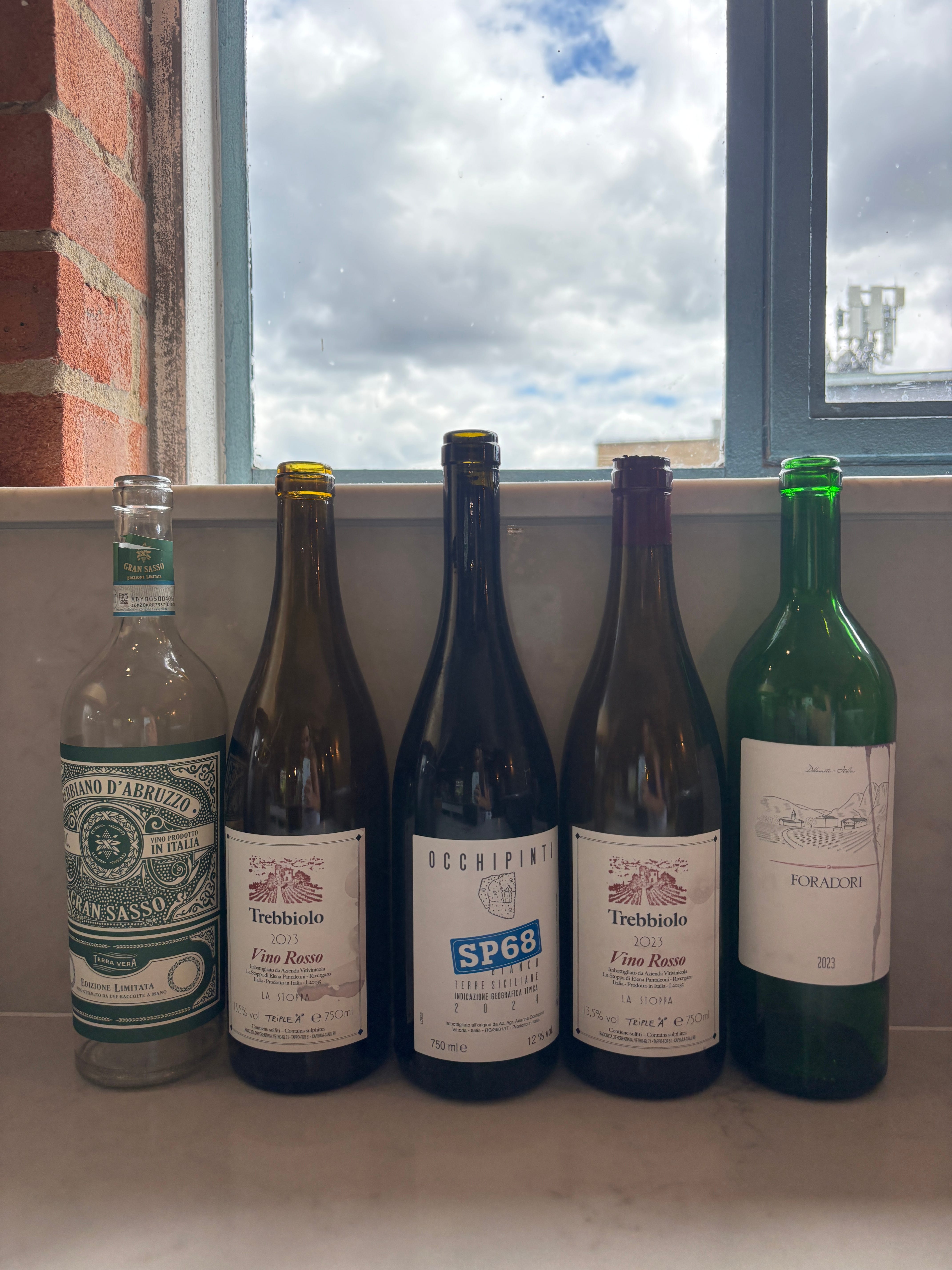
Except my budget couldn’t fully afford all of these iconic producers, so I had to draw the line at Abruzzo. In this region, I could get away with a fun, easy-drinking white wine to kick off the tasting while everyone was getting settled and munching on crisps and olives. I went with a producer named Gran Sasso, named after the highest peak in the Apennine Mountains, and it was an absolute crowd-pleaser. Of course, the wine that I was the least connected to personally, was many in the group’s personal favorites. Another surprising standout for most was Occhipinti’s white wine SP68, named after the oldest wine road ever recorded, where her vineyard sits in Sicily. Incredibly aromatic with lots of texture. A lot of my guests found it more palatable after taking a bite of their cheese, and then taking a sip of the brightly-flavored wine, and experiencing how the salt of the cheese softened the punchy edges from the Sicilian heat. Everyone could also taste how special the wine from Foradori was, how the fresh alpine air made a red wine taste so light and airy, but still inky and interesting. And to finish, La Stoppa was a showstopper, even on a steamy 34C day, this red wine with a hint of a chill still carried a burst of red fruit and was drinkable enough for everyone to desire one final glass.
If I may brag, I feel like I picked a pretty darn good lineup. Who’s coming to the next one? And which country should I feature next?
Cheers, y’all
Bailey
Loved this!